Our new strategic partnership with pioneering Danish company UV Medico strengthens the UK contamination control ecosystem.
FMS has formed a strategic partnership with UV Medico A/S, a pioneer in safe and efficient Far-UVC light-emitting devices at the forefront of chemical-free microbial decontamination and bioburden reduction in critical clean environments. The agreement sees FMS support and supply UV Medico’s entire range of cutting-edge Far-UVC (UV222) products to industries across the UK.
Far-UVC light is an innovative solution for decontamination and bioburden reduction in critical clean environments that demand the dramatic reduction or complete elimination of microbial contamination. Denmark-based UV Medico pioneered the application of Far-UVC technology in the human-safe ultraviolet light wavelength of 222nm (nanometres). The firm’s products use mercury-free Krypton-Chloride (KrCl) excimer lamps to emit Far-UVC light, which has been shown to effectively reduce airborne pathogens and viruses, including SARS-COV-2. Pathogens are easily spread through the air. They are difficult to control and are especially hazardous to immunocompromised patients or those with respiratory disorders. Far-UVC light at 222nm wavelength renders microorganisms inactive with no hazard to human health.
Adding the UV Medico range of UV222 products to the FMS portfolio of contamination control solutions perfectly complements our own environmental monitoring systems and airborne particle counters: UV Medico Far-UVC technology inactivates microbial particles and reduces the bioburden; our particle counters and monitoring products detect, measure and alert to the presence of harmful particles. The new partnership gives UK customers immediate access to rapid and effective Far-UVC decontamination solutions.
Our Commercial Director, Deborah Haisman, identifies a clear synergy in the new relationship with UV Medico:
“This partnership lets us collaborate to deliver safe, science-backed contamination control solutions across regulated markets in pharma, biotech, life sciences and healthcare – where FMS is already well respected. It means that we can combine Far-UVC technology with our real-time viable particle monitoring solutions in Grade A, aseptic and other critical clean spaces to further reduce microbial risk,” she says.
In addition to its evident decontamination applications in pharma research and manufacturing, Far-UVC technology also plays a significant role in rapid disinfection and infection control in ambulances and emergency medical vehicles, hospitals, clinical facilities, food preparation and serving environments, facilities & estates, and protects health and well-being in hygiene-critical public spaces. And that’s great news for our FMS technical team, as it helps to accelerate our expansion into these dynamic sectors by allowing us to integrate UV222 products alongside our range of contamination control solutions.
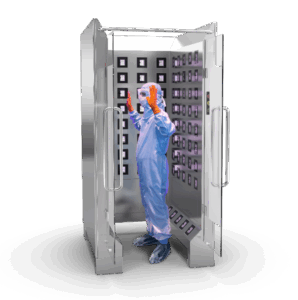 The UV Medico UV222 product ranges include Far-UVC solutions for cleanroom, healthcare and industrial applications. Among the innovative UV Medico cleanroom solutions that we know will be of great interest to many FMS customers is the UV222 Booth – a walk-in chamber positioned at the entrance to high-grade clean areas that decontaminates gowned personnel in less than 30 seconds.
The rapid decontamination that Far-UVC technology provides also safeguards clean environments against pathogens and microbial contaminants in industry sectors that already deploy FMS contamination control solutions. These include semiconductor fabrication and space vehicle assembly operations – where mould spores and microbes can harm yields and operational integrity, and degrade mission lifespans.
“Our partnership with UV Medico strengthens the contamination control ecosystem in the UK,” adds Deborah Haisman. “We can deliver comprehensive, compliant solutions for critical environments, backed by innovation and technical collaboration designed to meet the changing needs of industry across all market sectors – all supported by our nationwide service infrastructure.”